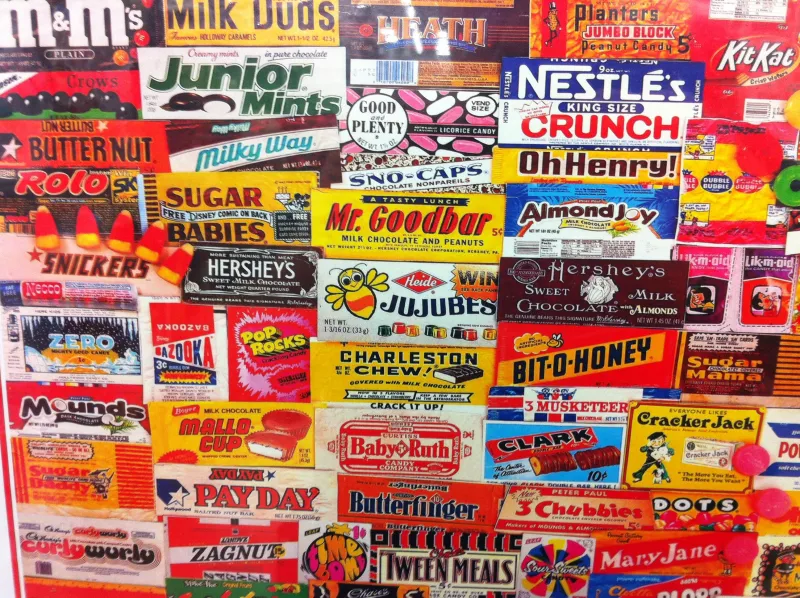
Born in a Different Decade, Hooked on a Different Sweet: What Milk Candy Reveals About Who You Are
Photo: NIAID, CC BY 2.0, via Wikimedia Commons
Ask someone about their favorite candy and you'll get a snack recommendation. Ask them about the first candy they ever truly loved, and you'll get something closer to a biography.
Milk-based candies have this particular superpower. Because they tend to be soft, creamy, and comforting — texturally tied to warmth and safety — they embed themselves in memory in ways that harder, sharper sweets just don't. There's real neuroscience behind that, but honestly, you probably already knew it in your gut. One bite of a particular milk caramel and you're suddenly nine years old again, standing in line at a corner store with sweaty quarters in your fist.
So let's talk about what those specific memories actually reveal. Because the milk candy you're most nostalgic for isn't random. It's a generational fingerprint.
The Boomer Baseline: Butter, Cream, and Simplicity
If you were born somewhere between the mid-1940s and early 1960s, your milk candy era was defined by straightforwardness. Brach's butter mints in their pastel little pillows. Kraft caramels wrapped in wax paper that took genuine effort to unwrap. Cow Tales, which showed up in the late '60s and became a lunchbox staple almost immediately.
These were candies built around a single, honest premise: dairy fat plus sugar equals happiness. There wasn't a lot of layering going on — no filled centers, no internationally inspired flavor profiles. The milk was the point. Boomers grew up in a post-war America where full-fat dairy was practically a patriotic act, and that cultural context absolutely shaped what ended up in the candy aisle.
Ask a Boomer about Kraft caramels and watch their face change. That's not just a food memory. That's an entire era of American life compressed into a chew.
Gen X: The Decade That Gave Us Weird in the Best Way
Generation X candy culture — roughly the late '60s through the '70s and into the '80s — got a little stranger and a lot more fun. This was the era when candy companies started experimenting more aggressively, and milk-based treats picked up some genuinely odd companions.
Milk Duds became a movie theater ritual. Rolos, though originally British, became deeply American by the time Gen X got hold of them. Tootsie Rolls, which have always occupied that ambiguous space between chocolate and milk candy, hit peak cultural saturation during this stretch.
But what really defines Gen X milk candy nostalgia is the occasion. Halloween hauls. Drive-in concession stands. Gas station candy displays that felt like treasure maps. Gen Xers didn't just eat milk candy — they experienced it in specific, highly contextual settings that are now inseparable from the memory of the candy itself. Take away the context and the candy loses half its meaning.
There's also a slight edge of scarcity in Gen X candy nostalgia. These weren't kids who could order anything online. If your regional grocery store didn't carry it, you simply didn't have it. That limitation made certain treats feel genuinely special in a way that's hard to replicate now.
Millennials: The Nostalgia Generation Who Never Stopped Shopping
Millennials — born roughly between 1981 and 1996 — are probably the most studied generation when it comes to candy nostalgia, partly because they're the ones most aggressively monetizing it. The entire vintage candy resale market runs substantially on Millennial dollars.
For this group, milk candy memories cluster around a few specific touchstones. Werther's Originals, which their grandparents kept in glass dishes. Caramel Apple Pops. The deeply specific pleasure of a Milky Way bar that had been sitting in a slightly warm car. And of course, the slow-burn discovery of international milk candies — White Rabbit from China, Milkita from Indonesia — that started showing up in Asian grocery stores and eventually went semi-mainstream.
Millennials are also the first generation to experience their childhood milk candy preferences as a brand identity. The "I was a [insert candy here] kid" construction is basically a Millennial invention. Candy preference became a personality shorthand, a way to signal your particular flavor of '90s childhood — suburban vs. urban, coastal vs. Midwest, latchkey kid vs. after-school program.
Psychologists call this "nostalgia as self-continuity" — using memories of past preferences to maintain a coherent sense of identity over time. Milk candies are unusually good at this because they hit multiple senses simultaneously. The smell, the texture, the way the sweetness blooms — it's a full sensory package that the brain files away with unusual fidelity.
Gen Z: Global Palates and the Reinvention of Creamy
Here's where it gets interesting. Gen Z's milk candy identity is genuinely different from every generation before them, and it's not just because they grew up with the internet.
Young people coming of age in the 2010s and early 2020s had access to a global candy aisle from basically birth. Korean milk caramels. Japanese milk candy assortments. Boba-flavored everything. The definition of "milk candy" expanded dramatically, and Gen Z's nostalgia — which is already forming, by the way, even for the youngest members of this cohort — is going to be far more internationally inflected than any previous generation's.
There's also a values layer here. Gen Z is more likely to seek out milk candies made with oat milk alternatives, or to be curious about the sourcing of the dairy. That's not to say they don't love a classic caramel — they absolutely do — but the relationship with the category is more complicated and more conscious.
Interestingly, Gen Z has also developed genuine nostalgia for candies they technically discovered through older relatives or retro marketing. Werther's, for example, has a surprisingly strong Gen Z following. The "grandma candy" framing became its own kind of ironic-then-sincere affection. Milk candy's generational transmission is alive and well.
Why the Cream Sticks Around
Here's the throughline across all of these decades and demographics: milk-based candies hold memory better than almost any other sweet category. The richness of dairy fat creates a longer sensory experience in the mouth, giving the brain more time to form an association. The softness signals comfort. The sweetness triggers reward pathways that get permanently linked to whatever emotional context surrounds the first encounter.
Your favorite milk candy isn't just a preference. It's a coordinate — a specific point on the map of your life that you can return to any time you want, for roughly the price of a handful of wrapped caramels.
So the next time someone asks what candy you grew up on, know that you're not just answering a trivia question. You're handing them a small piece of your timeline. And honestly? That's kind of beautiful.
Now go eat something creamy.